
In another example of her isolationist nonsense, Rep. Marjorie Taylor Greene introduced an amendment calling for the U.S. not to send funds to critical NATO infrastructure.


In a chaotic and increasingly polarized country, it would be nice to see strong and competent leadership in the nation’s highest legislative body, especially in the face of conflicts such as the war in Ukraine. Sadly, Rep. Marjorie Taylor Greene (R-GA) continues to remind us that not all legislators are created equal, as she proposed another amendment regarding the North Atlantic Treaty Organization, aka NATO. The amendment she introduced yesterday would ensure that NATO would not receive critical infrastructure funding. Her continued opposition to NATO’s existence is another reason to remove her from Congress.
Nonsensical Isolationism
This episode by Rep. Greene is not the first time she has called for the United States to separate from NATO in some way. Previously, she called for the complete withdrawal of the United States from the organization despite America being one of its founding members. Greene holds to an absurd narrative set by Trump, which argues that NATO is not meeting a so-called obligation by NATO member states to spend 2 percent of their GPD on their military. Greene hit on this note in her speech supporting her amendment, saying:
“America should not be doing out hundreds of millions of dollars to international organizations to help them fight their enemies, especially when they are unwilling to fight for themselves as of 2023, a majority of NATO countries do not meet their pledge to spend a minimum of 2% of their GDP on defense the United States has been financing and promising to defend NATO countries for decades and paying more than its fair share all while countries like Germany fail to fulfill their NATO obligations..”
NATO members have no legal or political obligation to spend 2 percent of their GDP on military concerns. In a previous article I wrote about Rep. Greene’s opposition to NATO, I noted that:
“The NATO goal of having its members pay 2 percent of their GDP towards their defense is far more complicated than Trump and Greene acknowledge. Firstly, the goal is aspirational and optional for membership in the alliance. Nothing in the NATO Charter, which we signed and ratified in 1949, requires that a nation meet that goal. No legal requirement exists for a nation to spend 2 percent of its GDP on defense. Furthermore, the payments are not made to the United States but are part of each nation’s spending budget. When Trump says that a nation has to pay for protection, he is fundamentally misunderstanding or willfully disregarding the facts of how NATO funds itself. I wouldn’t be surprised if Greene were making the same error.
Finally, while most NATO members don’t meet this threshold, they are improving. In 2023, 11 members met that threshold, and NATO expects that 18 members will meet this goal this year. The simple reality is that NATO members are working to achieve this goal and are under no obligation to do so simply because Trump thinks NATO members owe him money. Removing the U.S. from such an important alliance on such a ridiculous basis would not only undermine America’s reputation on the world stage, it would be disastrous to global stability.”
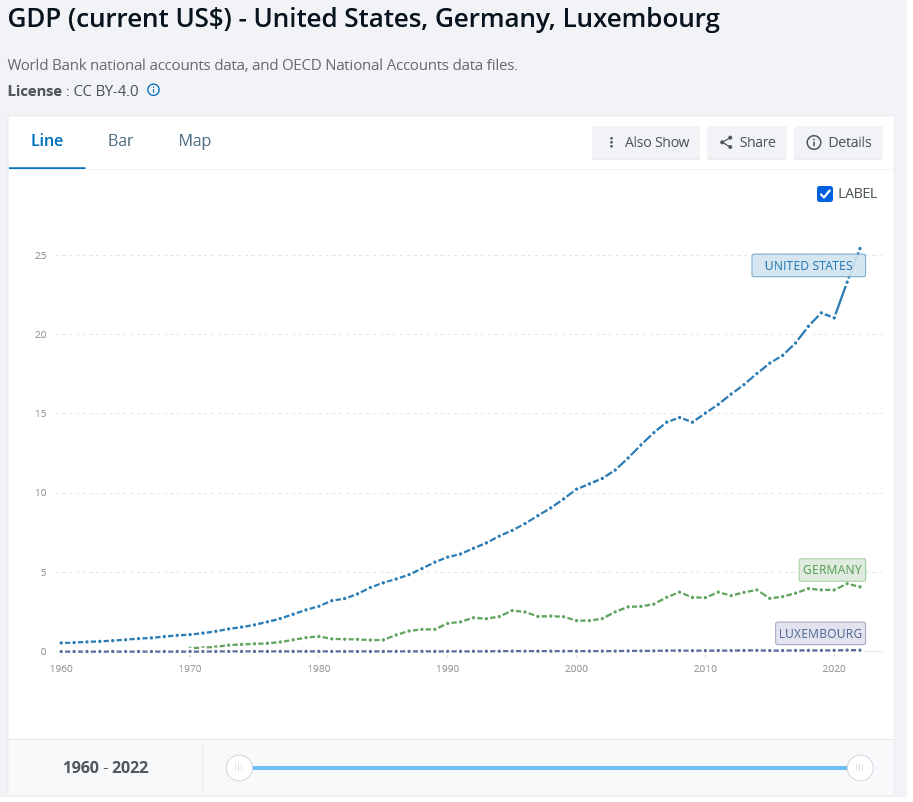
Simply put, Representative Greene is not only wrong, but she is painfully ignorant about the way NATO conducts itself or how its members are addressing the very concerns that she raises in her comments on the House floor. Moreover, it is important not to create false equivalencies between each NATO member’s ability to meet this aspirational threshold. Countries like Germany, which has a GDP of just over $4 trillion, will be able to spend much more and with greater efficiency than Luxembourg, which holds a GDP of $81.64 billion. For context, the United States’ GDP rests at around $25.44 trillion.
Contextualizing NATO Spending
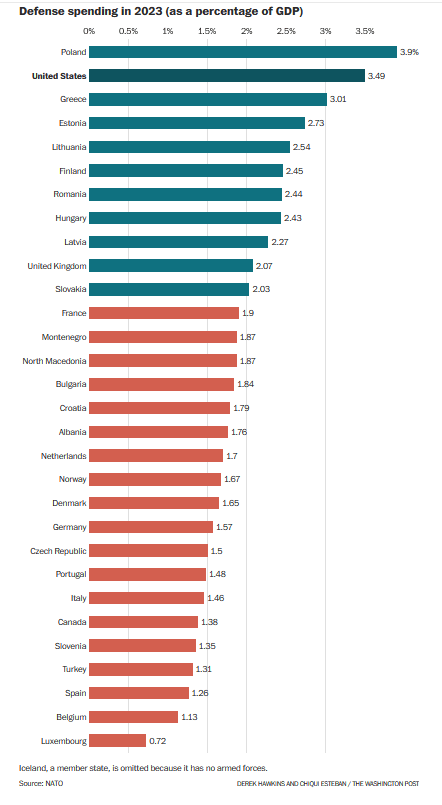
Another problem with Rep. Greene’s view of NATO spending lies not only in her isolationist solution to leave the alliance but in her understanding of who is spending on their militaries in the first place and how much they are spending relative to their economies. While the United States spends the most as a total military spending in the alliance, it would be a mistake to think that the U.S. is the largest spender relative to its economy. If we look at military spending as a percentage of its GDP, the United States, which, again, has a GDP of over $25 trillion, spends roughly 3.49 percent on its military as of 2023. By contrast, Poland, which has a GDP of $688.13 billion, spends an estimated 3.9 percent of its GDP on defense. In other words, despite being far less wealthy than the United States, Poland actually puts more of its economy towards its defense.
Even with the spending issue aside, it is important to note who meets the 2 percent guidelines. Of the 11 countries, the majority are Eastern European, meaning they are closer to Russia than countries like Germany or Spain, which don’t meet the 2 percent goal. Poland, in particular, has a history of Russian aggression. Only the United States and the United Kingdom can safely say they are not close to Russia. In other words, the countries that spend the most as a percentage of their GDP are those most at risk of Russian aggression. Getting other countries to rearrange their economy when they have previously not had to do so requires time, diplomacy, and patience. Representative Greene lacks the strength of character to appreciate all of these necessary components.
If we are to meet the standards that Rep. Greene demands, our leaders must understand not only the threat that Russia poses to the stability of the world but also the historical and strategic context of the very spending we are examining in the first place. NATO is an imperfect alliance, but with care and proper cultivation, it can and will work to advance American national security.
If you like my work and want to support me, you can find the donation site through my Kofi account. I really appreciate it.
References
“GDP (Current US$) – United States, Germany, Luxembourg | Data.” https://data.worldbank.org/indicator/NY.GDP.MKTP.CD?locations=US-DE-LU (June 6, 2024).
Hawkins, Derek. 2024. “See Which NATO Countries Spend Less than 2% of Their GDP on Defense.” Washington Post. https://www.washingtonpost.com/politics/2024/02/12/nato-countries-defense-spending-gdp-trump/ (June 6, 2024).
JUST IN: Marjorie Taylor Greene Introduces Amendment To Block Funding For NATO And Ukraine. 2024. https://www.youtube.com/watch?v=z3HdaBuIs6A (June 6, 2024).
Kelly, Conor. 2024a. “Expel Marjorie Taylor Greene.” The Progressive American. https://progressiveamerican322183019.wordpress.com/2024/05/17/expel-marjorie-taylor-greene/ (June 6, 2024).
Kelly, Conor. 2024b. “Marjorie Taylor Greene Wants To Withdraw from NATO: A Disastrous Idea.” The Progressive American. https://progressiveamerican322183019.wordpress.com/2024/04/18/marjorie-taylor-greene-wants-to-withdraw-from-nato-a-disastrous-idea/ (June 6, 2024).
“Marjorie Taylor Greene Calls for U.S. Withdrawal from NATO.” 2023. Newsweek. https://www.newsweek.com/marjorie-taylor-greene-calls-us-withdrawal-nato-1812339 (June 6, 2024).
Rissman, Kelly. 2023. “Marjorie Taylor Greene Introduces Amendment Directing Biden to Withdraw from Nato.” The Independent. https://www.the-independent.com/news/world/americas/us-politics/marjorie-taylor-greene-nato-biden-b2373800.html (June 6, 2024).


Leave a Reply